|
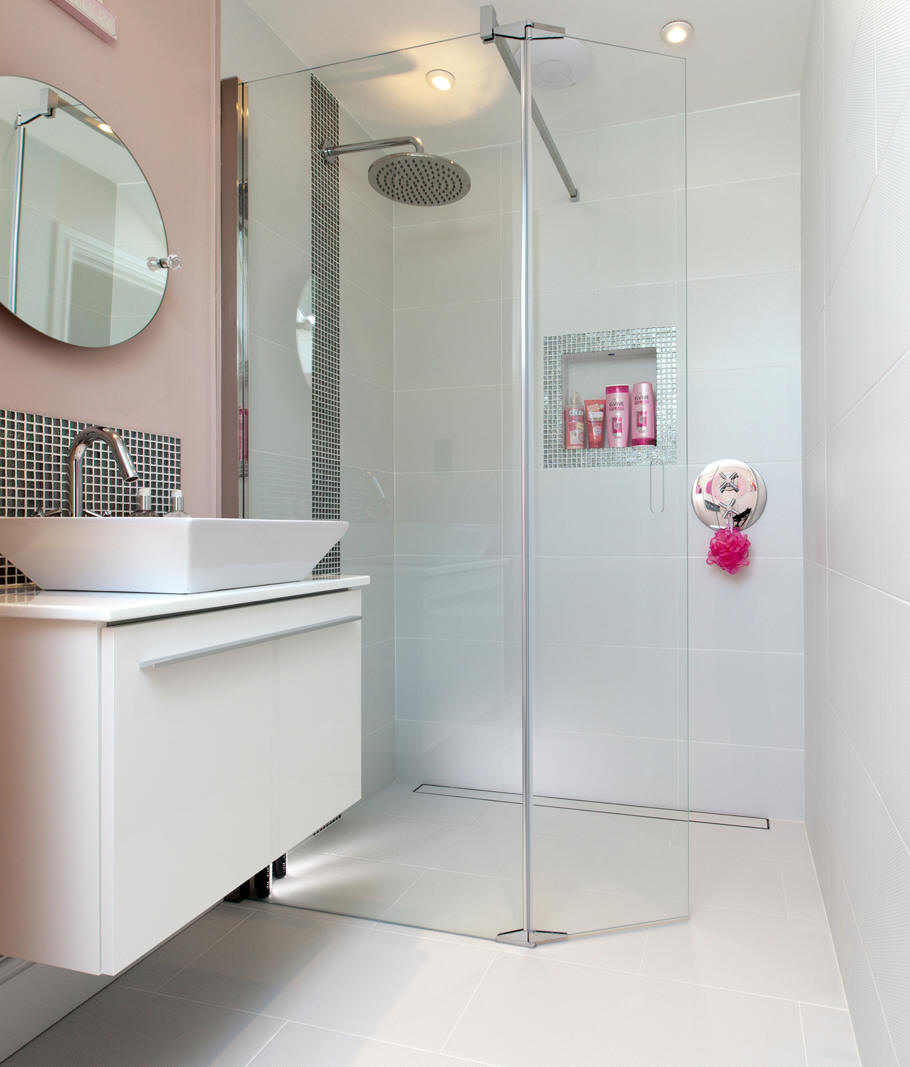
So, what is a wet room?
Put simply, a wet room
is an area that is happy to get drenched.
This could be an entire room or part of a
room that has been specially prepared so it
can be drenched without leaking into the
fabric of the building causing structural damage. Water
runs across the area towards a gully in the
floor and off into a drain.
What are the advantages of a wet room
shower?
Wet room showers are
generally considered to be aesthetically
pleasing. With no obvious lines to define
where the shower area begins the room can
feel bigger and more spacious as the shower
area now appears to be part of the bathroom,
not something poked in the corner.
Not only can wet rooms
present as the height in fashion, they are
also very practical.
A wet room has fewer
nooks and crannies in which dirt can
congregate making it so much easier to
clean and keep clean than a more traditional
installation with a shower tray.
If stepping up into a
shower tray presents a problem or wheelchair
access is necessary there is simply nothing
better than truly level access.
What are the disadvantages of a wet room
shower?
The single biggest
disadvantage of a wet room shower lies in
its creation. It is fair to say that a wet
room costs more to install as the process of
installation takes more time and requires
more components.
When tiling the floor
in a wet room shower consider what type of
tile you use in the shower area. You don't
want to create a super-slippery floor that
could become a hazard when wet. Maybe
consider a tile that is textured.
The logic behind a wet
room is fairly simple, but particular
attention should be paid to two key elements:
1. The floor in the wet area must slope towards
a drainage
gully.
Not surprising when you
think about it. Water needs to run towards a
drain.
As water will always run
downhill the gentle incline of your floor
must slope towards a drainage gully. The
gradient need only be slight, but it must run towards the
drainage gully or disaster will ensue!
It is surprising how
many stories there are about water running
out of the bathroom door and down the stairs
where a person calling themselves an
installer has failed to respect this simple
principle.
When creating a wet
room shower we can supply various products
that ensure the technical and often tedious
task of creating a slope towards a drain is
fulfilled swiftly and accurately. For timber
floors these products are known as 'Floor
Formers' - a prefabricated deck that simply
replaces a section of timber floor in
minutes.
There is also a number
of drainage solutions for solid screed
floors.
2. The wet room should be 'tanked'.
Tanking is a process
whereby a waterproof membrane is applied to
the designated 'wet area' before the
finished floor covering is applied. It
protects the fabric of the building should
the worst happen and your floor covering
springs a leak.
Buildings breathe.
Throughout their existence they will move,
expanding and contracting with changes in
ambient temperature, or subtle movements in
the ground below the building. The floor of every
building moves. This process can be due to
several factors, but probably the most common
reason will be a change in temperature
whereby the floor expands and contracts as
it heats and cools. Whatever the reason the
result will be the same if you have a tiled
floor finish, unless you put in place
measures to counter the effect.
Floor and tiles will
expand and contract at different rates as
each will have a different coefficient of
expansion. This can create a problem where
your floor and your tile are acting
independently and in opposition to each
other. The result can be anything from the
grout lines developing micro-porous cracks
to the tile actually cracking. The
consequence of each will be the same - water
will penetrate. This is where a tanking
membrane under the tile becomes your
insurance policy against the onset of
structural dampness. Anything that makes its
way beneath the tile can go no further.
We supply a tanking
membrane known as
TileSure. This
clever product seeks to tackle the problems
caused by differing coefficients of
expansion in two ways.
Firstly, TILESURE is
waterproof. This is to say water cannot
penetrate through this tanking product.
Click the link to learn more about the
product.
Secondly, TILESURE
offers a property that virtually no other
tanking membrane does - decoupling. This is
where the membrane actually allows the
sub-floor and the tiled floor surface to
expand and contract at different rates by
offering an elastic layer between the two.
A tanking membrane
should be regarded as an absolute necessity,
not an option. Consider, if you don't use a
membrane you are playing Russian Roulette.
If the worst happens you will have no
alternative than to dig the floor up, repair
the damage caused by the ingress of water
and start again. Why risk it?
Using a vinyl floor covering
You might wish to use a
non-slip vinyl floor covering such as Altro
Flooring instead of tiles. Doing so can
overcome a few of the issues that a tiled
floor creates.
Non-slip vinyl is great
for a shower area as it does away with the
worry of slipping when the floor is wet.
Being impermeable to
water, a vinyl floor covering does away with
the need for a waterproof membrane as the
vinyl itself becomes the membrane.
Vinyl floor coverings
can be coved upward where they meet with
walls, further enhancing their waterproofing
properties.
Vinyl floor coverings
do however need specialist installation.
This is not a job for a DIYer.
Vinyl floors although
highly functional can look a bit
institutional and lack colour or design
choice. |